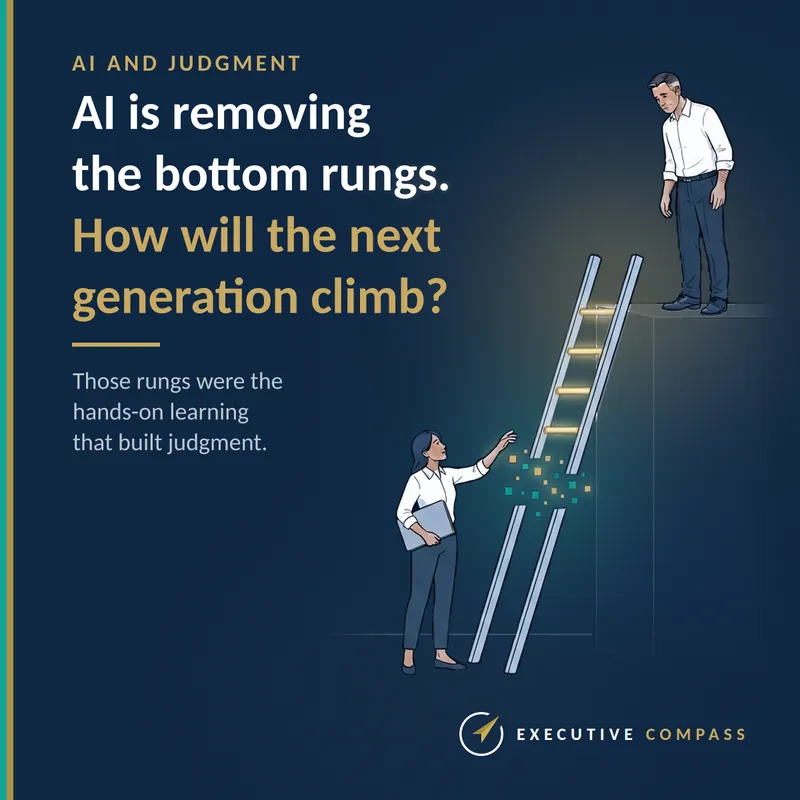
The work AI now saves junior engineers from is the work that made me senior.
At Lockheed Martin, one memory corruption defect in the tank simulator took me three days to find. I was wrong about the cause more than once. By the time I found it, I knew that system better than any document could have taught me, and I could spot that kind of problem for years afterward. It was slow and inefficient. It was also where my judgment came from.
This is not an argument against the AI tools. They are useful, and they are not going away. But there is a question I do not think we have answered. If AI writes the first draft for the next generation, where will their judgment come from?
Senior engineers can use these tools well because they can tell when the output is wrong. A junior engineer with the same tool and none of that experience gets a plausible answer and no way to evaluate it. So does a junior scientist or analyst who sees a model’s first read of the data before forming their own.
For software engineers, there is now evidence. Researchers at Anthropic ran a controlled study with 52 mostly junior software engineers learning a new coding library. Afterward, the group that used AI scored 50% on a quiz about the concepts they had just used. The group that coded by hand scored 67%. The biggest gap was in debugging, the skill of knowing when code is wrong and why.
In the same study, scores tracked how people used AI. Those who asked it to explain its code or the concepts averaged 65% or more. Those who let it write the code and fix the problems averaged under 40%. Habits like these are something leaders shape. That makes building judgment a leadership job. It is a question I raise with the leaders I coach.
Three things I suggest leaders be deliberate about right now.
- Keep hiring and growing early-career people, even as AI takes over some of their work. The senior people you will need to check AI’s work have to come from somewhere.
- Expect people who are still learning the craft to use AI as a tutor, not a ghostwriter. Ask them to walk you through AI-written work and show you where it could fail.
- Protect the struggle where judgment forms. Give early-career people a real problem to diagnose, like a defect or a failed experiment, and let them work on it before they turn to AI. Pair them with a senior person who explains what to check first, and why.
The organizations that get this right will have a real advantage in five years. The ones that treat it only as a productivity question will end up with a strong senior layer and very little underneath it.
AI can write the first draft. It cannot give anyone the three days I spent being wrong.
Discuss this post on LinkedIn →
Sources
- Judy Hanwen Shen and Alex Tamkin, “How AI assistance impacts the formation of coding skills,” Anthropic, January 2026.
- On hiring: Erik Brynjolfsson, Bharat Chandar and Ruyu Chen, “Canaries in the Coal Mine?” Stanford Digital Economy Lab, revised August 2026. Employment of workers aged 22 to 25 in the most AI-exposed jobs is 19% below where it would be had it kept pace with less-exposed peers, mostly because fewer young people are being hired.
First published on LinkedIn on October 14, 2026.