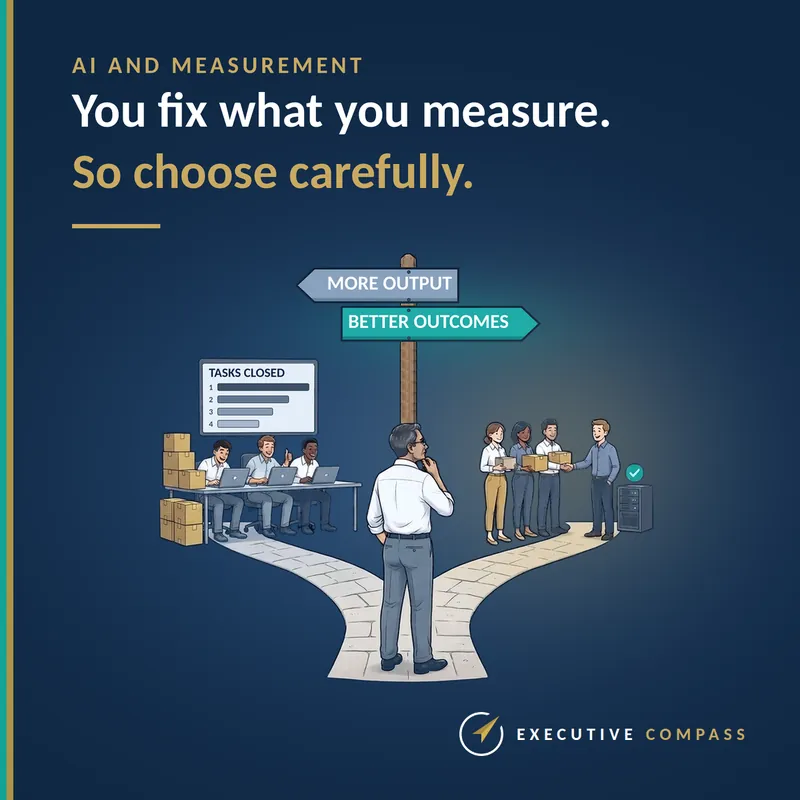
When AI usage became a target at Amazon, some employees ran trivial tasks just to push it up. AI is making it easier to produce more. So we should ask ourselves whether we’re measuring more output or better outcomes.
I believe in “you fix what you measure” because most people want to do the right thing, and they read a measure as a signal of what that is. Set a target for pull requests per engineer, and conscientious engineers will deliver more pull requests. When a measure produces the wrong result, the problem is usually the measure, not the people.
Amazon had a goal for more than 80% of its developers to use AI tools every week. An employee-built leaderboard ranked people by AI usage. The Financial Times reported that employees felt pressure to increase their usage for the sake of the numbers. Amazon shut the leaderboard down, and an SVP told staff, “Please don’t use AI just for the sake of using AI.” If AI adoption was the goal, it was achieved. Whether anyone became more productive is a different question. That’s Goodhart’s law: when a measure becomes a target, it can stop being a useful measure.
Activity measures still have a place. In my engineering leadership roles, I preferred measures closer to what customers and the system experienced: customer-reported defects, open bugs, mean time to recover from an incident, and time from code check-in to deployment.
At Cisco, our first production deployment of a new product took more than 12 hours. We were disappointed, so we set an aggressive goal of 20 minutes. The team paid down technical debt and automated the process, and after more than a year, we got it down to 40 minutes. We missed the goal, but cut deployment time by more than 90%. The goal gave the team real motivation to win.
In the Systems Thinking sessions I teach through Executive Compass, I give leaders one test for every number on their dashboard. Could it improve while your customers notice nothing, or even experience something worse? If so, look past the number to the behavior it encourages.
A question for you
What is one number you stopped tracking, or changed, because it was steering your team the wrong way?
Answer on LinkedIn →Sources
- Goodhart’s law comes from economist Charles Goodhart (1975). The common wording, “When a measure becomes a target, it ceases to be a good measure,” comes from anthropologist Marilyn Strathern (1997).
- The Amazon details are from the Financial Times, May and June 2026, including “Amazon scraps AI leaderboard to stop workers chasing usage scores.”
First published on LinkedIn on October 21, 2026.